What Is Changing with EU Imports on 1 July 2026?
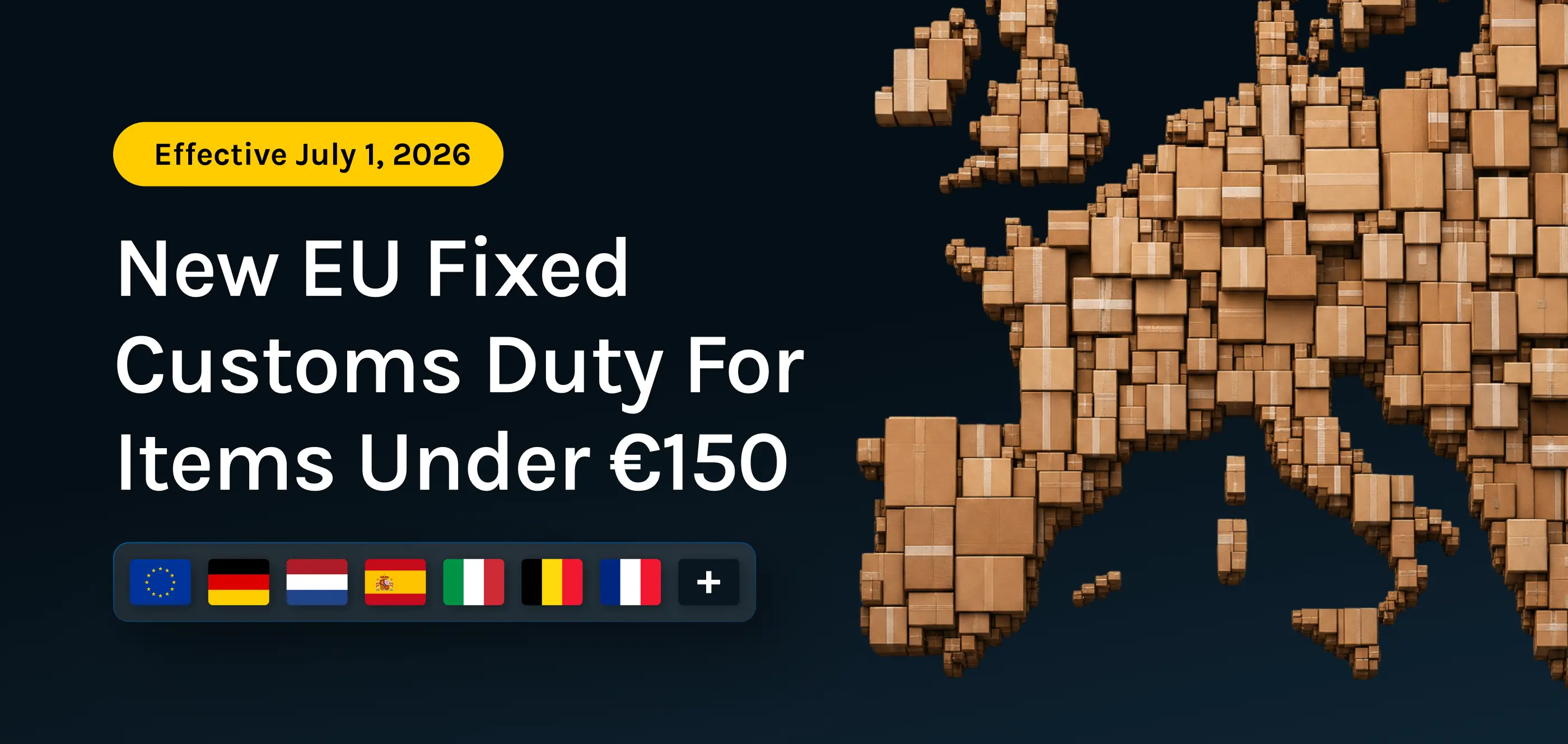
The EU is ending duty-free treatment for low-value imports and introducing a flat, temporary customs duty in its place. The change is part of a broader EU customs reform, driven by the scale of low-value eCommerce: according to the European Commission (June 2026), almost 5.9 billion low-value items were shipped directly to EU consumers in 2025 (up from roughly 4.6 billion in 2024), with around 91% originating from China.
EU inspections also found that a majority of checked low-value goods in categories such as cosmetics, toys and electronics failed to meet EU safety standards. The Council of the EU (December 2025) expects the reform to raise about €1 billion a year in customs revenue.
| Change |
Date |
What It Means For Sellers |
| €150 duty-free threshold removed |
2026-07-01 |
Low-value imports are no longer duty-exempt by default. |
| Temporary €3 customs duty begins |
2026-07-01 |
A flat €3.00 applies per item type to goods ≤ €150 from outside the EU. |
| Product identifiers voluntary |
2026-07-01 |
Carriers can start collecting PID data ahead of enforcement. |
| Product identifiers mandatory |
2026-11-01 |
Required on relevant B2C shipments (carrier-dependent). |
| EU-wide handling fee under discussion |
Not yet adopted |
A separate per-parcel fee has been proposed but not finalised. |
| Temporary duty expected to end |
2028-07-01 |
Normal customs tariffs expected to replace the flat €3.00 under the EU Customs Data Hub. |
The simplest way to see the change is by shipment value. The reform only affects what happens below €150 — shipments above that threshold already paid duty and continue to:
| Shipment Value |
Until 1 July 2026 |
From 1 July 2026 |
| Below €150 |
VAT only |
VAT + new €3.00 duty (per item type) |
| Above €150 |
VAT + standard duty |
VAT + standard duty (unchanged) |
How Does the New €3 Small Parcel Duty Work for eCommerce?
The new €3 customs duty applies to shipments entering the EU valued at or under €150. The €3 duty is charged per item type within a parcel, based on tariff classification (HS code) and country of origin, not once per parcel and not per physical unit. Items that share the same classification are grouped onto a single customs declaration line and carry a single €3 charge; a different product type creates a new line and another €3.
In the EU's own examples, a parcel of five identical T-shirts incurs one €3 charge, while a T-shirt plus a watch incurs €6. So the cost impact scales with how varied an order is, not how many units it contains.
Worked example: why the €3 stacks on multi-SKU orders
A seller ships three items to a B2C customer in Germany, declared value €80:
| Item |
Description |
Hs Code |
Country Of Origin |
€3 Charge? |
| 1 |
Cotton T-shirt (blue) |
6109.10 |
Bangladesh |
Yes — first item type |
| 2 |
Cotton T-shirt (red) |
6109.10 |
Bangladesh |
No — same classification as item 1 |
| 3 |
Denim jeans |
6203.42 |
Bangladesh |
Yes — different item type |
Chargeable lines: 2 → duty = 2 × €3 = €6.
The two T-shirts group onto one line; the jeans form a second. Country of origin can also split a line where the declaration requires it — for example, identical T-shirts sourced from two different countries may be treated as two item types depending on the carrier and clearance process. The practical lesson: accurate HS codes, product descriptions and country-of-origin data directly determine what you pay.
Easyship tip: This grouping logic — HS code, item type and country of origin per declaration line — is exactly how Easyship computes the duty on each EU-bound shipment, so a mixed-SKU order is priced correctly instead of guessed at a flat €3.
How VAT interacts with the duty
The €3 duty is not a standalone line item. It is included in the dutiable value before VAT is calculated, so VAT applies to the goods value plus the duty — the two stack. VAT is charged at the rate of the destination EU member state (a parcel to Germany at 19%, one to France at 20%), so the same order costs a different amount depending on where the customer lives. In practice the final cost of a low-value shipment is slightly higher than goods value + €3, because VAT is charged on that combined figure.
The one exception is IOSS: where a sale is cleared under the Import One-Stop Shop, VAT is collected at checkout on the sale itself and is not applied to the €3 duty (VATCalc analysis of the Commission clarification). For shipments cleared without IOSS — how most low-value parcels, including those processed through Easyship, are handled — the duty sits inside the VAT base.
For sellers, the practical takeaway is to model landed cost as goods value, plus €3 per chargeable line, plus VAT on the combined amount, not as a flat €3 add-on.
What Are the Three New EU Product Identifiers?
Alongside the duty, EU B2C shipments increasingly require product identifiers (PIDs) so customs can trace goods and target unsafe products. The requirement is largely carrier-driven: FedEx and UPS require them on EU B2C customs data, while some carriers (such as DHL) currently do not. Sellers should prepare three fields per item:
- Merchant Product Identifier: the seller's own SKU, listing ID or internal product code.
- Manufacturer Product Identifier: the code assigned by the manufacturer or supplier.
- Standardised identifier (GTIN, EAN or UPC): a barcode, where one exists (optional if not).
PIDs are voluntary from 1 July 2026 and mandatory from 1 November 2026 on relevant B2C shipments. Even where optional, start populating them now to avoid clearance friction, and note that a registered VAT ID can exempt a shipment from the PID requirement.
An important shortcut: add your VAT ID, or the VAT ID of the recipient
Merchants who register a VAT ID on their shipping account are exempt from the product identifier requirement. If you ship regularly to the EU and do not yet have a VAT ID, registering one is the most straightforward way to simplify compliance ahead of the November deadline.
For marketplace sellers, such as those selling on Amazon or other platforms, it is worth noting that most marketplaces do not currently store the specific identifiers the EU requires. Sellers in this situation should monitor whether their marketplace updates its systems to include these fields, or consider alternative compliance routes such as VAT registration.
What Does This Mean for Your EU Customers?
If duty and VAT are not collected at checkout, the carrier collects them on delivery, leaving your customer with an unexpected bill before they can receive their parcel. Surprise charges are a leading cause of refused deliveries, chargebacks and negative reviews.
The fix is to show the full landed cost at checkout, known as a DDP (Delivered Duty Paid) flow. The alternative, DDU (Delivered Duty Unpaid), leaves the customer to settle charges on arrival and tends to result in abandoned parcels and support tickets.
Easyship tip: Calculate duty and VAT per shipment and surface it at checkout so EU buyers see one all-in price. For low-value, multi-SKU orders, where the €3-per-item-type duty is hardest to estimate, an accurate at-checkout figure is the difference between a smooth delivery and a parcel that comes back.
Will the New Duty Apply to eCommerce Returns?
For now, yes. Most systems cannot yet distinguish an outbound B2C order from an inbound consumer return at the customs level, so the duty applies to returns too, and it is not automatically refundable once goods enter free circulation. Returned Goods Relief may reduce or remove the duty for items originally exported from the EU, but it depends on the customs procedure and documentation. Model returns conservatively rather than assuming the duty is recoverable.
Watch Out for National Fees on Top of the EU duty
The €3 EU duty is not the only new cost. Several member states are adding their own low-value parcel fees, separate from the EU charge:
| Country |
Fee |
From |
Notes |
| Romania |
RON 25 (≈ €5.00) |
2026-01-01 |
Per parcel on non-EU items under €150. |
| France |
€2.00 |
~2026-03-01 |
On non-EU parcels ≤ €150; can apply per declaration line. |
| Italy |
€2.00 |
2026-07-01 (postponed) |
Customs administration fee on non-EU items under €150, excluding documents. |
Italy's €2 fee was postponed to 1 July 2026 (VATCalc). These are national measures that may still change as authorities finalise implementation, so treat the dates as current-best rather than fixed.
What Happens After 1 July 2028?
The €3 duty is explicitly temporary. It is expected to apply until 1 July 2028, when the EU Customs Data Hub becomes operational for eCommerce goods and normal, product-specific customs tariffs are expected to replace the flat fee. In other words, July 2026 is the first phase of a multi-year customs reform, not the last change sellers will need to plan for.
What eCommerce Sellers Should Do by July 1st 2026
| Action |
Why It Matters |
| Audit product data (HS codes, country of origin, descriptions, values, weights) |
These fields directly determine how many €3.00 lines a parcel triggers and whether it clears cleanly. |
| Add HS codes to every SKU |
Classification is the basis of the duty calculation. |
| Capture VAT ID / EORI for business buyers |
Ensures B2B shipments get the correct customs treatment, not the flat €3.00. |
| Populate product identifiers now |
Voluntary today, mandatory 2026-11-01; FedEx/UPS already expect them. |
| Re-model landed cost per chargeable line |
Avoids under-pricing multi-SKU orders; revisit free-shipping thresholds and bundle pricing. |
| Decide your DDP vs DDU strategy |
Determines whether the customer or you absorb duty/VAT at the border. |
| Review returns assumptions |
Duty may not be refundable; document for Returned Goods Relief where eligible. |
| Track national fees |
Romania, France and Italy add costs on specific lanes. |
The EU €150 De Minimis Is Now Gone
From 1 July 2026, low-value imports into the EU lose their duty-free status and pick up a temporary €3 charge per item type, with VAT calculated on top in most (non-IOSS) cases. The cost is hardest to predict on varied, multi-SKU orders, and several countries are layering their own parcel fees on top. The sellers who cope best will be the ones whose product data — HS codes, country of origin, identifiers — is clean before July, and whose shipping setup calculates duty and VAT automatically rather than estimating a flat fee.
How Easyship can help you calculate the €3 duties at checkout
The hard part of this reform is not knowing the €3 exists — it's calculating it correctly, order by order, when the charge depends on HS code, item type, country of origin, destination and clearance model, and when VAT may or may not stack on top.
That's exactly what Easyship automates. For Shopify, WooCommerce and Amazon sellers, Easyship calculates duty, tax and VAT automatically for every shipment, supports both DDP and DDU so you control who pays at the border, stores HS codes and country-of-origin data at the product level, prepares product identifiers for EU-bound parcels, and captures recipient VAT/EORI details to apply the right treatment. Bulk CSV upload and API mapping let you get catalogue data ready before PID enforcement begins, so nothing is missing when you create a label.
Prepare for the 2026 EU parcel changes with Easyship — accurate duty and tax on every shipment, DDP or DDU, and the courier options to keep European orders moving. Try Easyship for free.
FAQs On The Changes To EU Imports for eCommerce
What is the new EU small parcel duty and when does it take effect?
A temporary €3 customs duty on qualifying low-value goods (≤ €150) imported into the EU from outside the bloc, starting 1 July 2026 and expected to run until 1 July 2028. It replaces the previous €150 duty-free exemption.
What if my customer is VAT registered?
Ensure that you have this information ready and enter it when prompted during the shipment creation. This will change the shipment to a B2B shipment, adding the ad valorem rate instead of the €3 fixed customs duty
How do I add a VAT ID?
If you already have a valid EU VAT ID, add it to your shipping account before November 1, 2026 so it can be included in your shipment data. If you do not have one, confirm whether your business needs EU VAT registration, IOSS registration, or marketplace-supported VAT collection. Once registered, check that your shipping platform and courier can store and transmit the VAT ID correctly to avoid missing data or duplicate VAT charges.
What are the three new EU product identifiers?
A merchant product identifier, a manufacturer product identifier, and a standardised identifier (GTIN/EAN/UPC) where available. They are voluntary from 1 July 2026 and mandatory from 1 November 2026 on relevant B2C shipments, and are required today by carriers such as FedEx and UPS.
Can I avoid the product identifier requirement?
Yes. Merchants or recipients with a valid VAT ID registered on their shipping account are exempt from the product identifier requirement. With Easyship, you can add your VAT ID to your account so it can be included in your shipment data where required, helping simplify EU compliance ahead of the November 1, 2026 deadline. This is one of the easiest ways for frequent EU shippers to reduce manual data requirements and avoid missing shipment information.
Does the duty apply to B2B shipments?
B2B shipments with a valid VAT ID or EORI generally follow normal commercial customs rules and standard ad valorem duty rates rather than the flat €3. Provide the buyer's VAT ID or EORI at shipment creation, and confirm exact treatment with your carrier or broker.
Will return shipments be charged the new €3 duty?
For now, yes. Current systems cannot distinguish between outbound B2C shipments and inbound customer returns, so the duty applies to both. Return Goods Relief may be available for items originally exported from the EU, but the technical implementation of this relief is still being worked out.
IMPORTANT: The information provided in this blog is for educational purposes only and does not constitute legal, tax, or financial advice. Laws differ by jurisdiction and change regularly. You should not rely on this content as your sole source of information. If you have specific concerns, please consult a qualified professional.
.svg)
.svg)




.svg)




.svg)
.svg)
.svg)

.svg)
.svg)