If you're sending a package from Germany to Switzerland, you'll need a completed customs declaration, an accurate commercial invoice with the item's value and HS code, and a courier that can clear Swiss customs on your behalf. Most shipments clear within 1 to 3 working days if the paperwork is correct. Businesses selling regularly into Switzerland also need to watch a separate VAT registration rule, which we cover below.
For eCommerce sellers, this is where Easyship helps directly: it generates the correct customs forms for you at checkout, based on the product data already in your store, so you're not filling out a CN22 by hand for every order.
By the end of this guide, you'll know which forms to file, what VAT you'll actually owe, and which courier fits the shipment in front of you. That's just as true for a Shopify or WooCommerce store shipping a few dozen orders a month as it is for a fulfillment operation sending hundreds of packages into Switzerland every week
What are the Rules for Shipping to Switzerland from Germany?
Switzerland sits inside Europe but outside the EU customs union. That means goods moving from Germany to Switzerland are treated as an export from the EU and an import into a separate customs territory, even though there's no passport control at the border.
That single fact drives everything else in this guide.
Parcels need a customs declaration, import VAT applies, and the intra-EU shipping rules you're used to (no customs paperwork, no import tax) don't apply here.
Switzerland does have a free trade agreement with the EU that removes tariffs on most industrial goods. But "no tariff" isn't the same as "no paperwork." You still declare the shipment; you just may not owe duty on it.
How much Does it Cost to Send a Package to Switzerland, and how much is VAT?
Cost has two parts: the courier's shipping rate, and Swiss import VAT, which is 8.1% and only gets charged when the VAT owed is more than CHF 5. In practice, that means goods worth less than around CHF 62 usually cross duty and tax free.
So if you’re looking to compare live courier rates for this route, Easyship shipping rate calculator for Germany to Switzerland gets you the biggest discounts (up to 91% off for some couriers)
For instance, the cost and timeline to ship a package weighing 0.5kg shipping from Germany to Switzerland can be calculated using the calculator.
| Courier |
Delivery Time |
Total Cost |
| UPS Standard |
3 working days |
€14.81 |
| UPS Express Saver |
1 working day |
€38.27 |
| UPS Express |
1 working day |
€56.07 |
| DHL Economy Select |
2 to 5 working days |
€52.98 |
| DHL Express Worldwide |
2 to 5 working days |
€72.29 |
| DHL Express 12 |
2 to 5 working days |
€84.28 |
One rule that catches sellers off guard: if your store sells more than CHF 100,000 a year into Switzerland in low-value goods, Swiss customs requires you to register for Swiss VAT and charge it at checkout instead of collecting it on delivery. Below that threshold, VAT is collected from the customer when the parcel arrives.
To check what VAT a specific order will owe before you ship it, use the Easyship duties and taxes calculator. It's one of the fastest ways to quote a landed cost to a Swiss customer up front, rather than surprising them at delivery
What Documents Do You Need to Ship to Switzerland?
Every parcel needs a customs declaration form: CN22 for lower-value, lighter shipments, and CN23 for higher-value or heavier ones, plus a commercial invoice listing the goods, their value, and an HS (tariff) code for each item.
Private senders can usually fill out a CN22 at the post counter. Business shippers sending regular volume should generate these electronically, since manual forms are the biggest source of delay and rejected shipments. If you're shipping through a platform, that means pulling the invoice value and HS code straight from your product catalog rather than typing them in per order.
Business customers repeatedly shipping into Switzerland should also register with Swiss customs for a client number, which speeds up clearance on every subsequent shipment.
What Happens if Your Customs Paperwork is Wrong?
Undervaluing a shipment or leaving out the HS code doesn't just risk a delay. Swiss customs can hold the parcel, return it to the sender at the sender's cost, or charge the correct duty plus a penalty once the error is caught.
The most common mistake is writing "gift" with no value to try to dodge VAT. Customs officers check this against the courier's own valuation data, and a mismatch flags the parcel for manual review, which usually adds several days. Couriers apply their own de minimis and clearance rules on top of Swiss customs rules so a form that satisfies Swiss customs can still get flagged internally by the courier if the invoice value looks inconsistent.
Are there Restricted or Special Items for Swiss Shipments?
Yes. Meat, dairy, and some plant products need import permits and are often stopped at the border without one. Medication requires proof of prescription above small personal quantities. Alcohol and tobacco carry their own duty rates on top of the standard 8.1% VAT, and counterfeit goods are seized outright.
If you sell in any of these categories, check the item against Swiss customs' restricted and prohibited goods list before you ship, not after a parcel gets held.
Which Couriers Handle Germany-to-Switzerland Shipments Best?
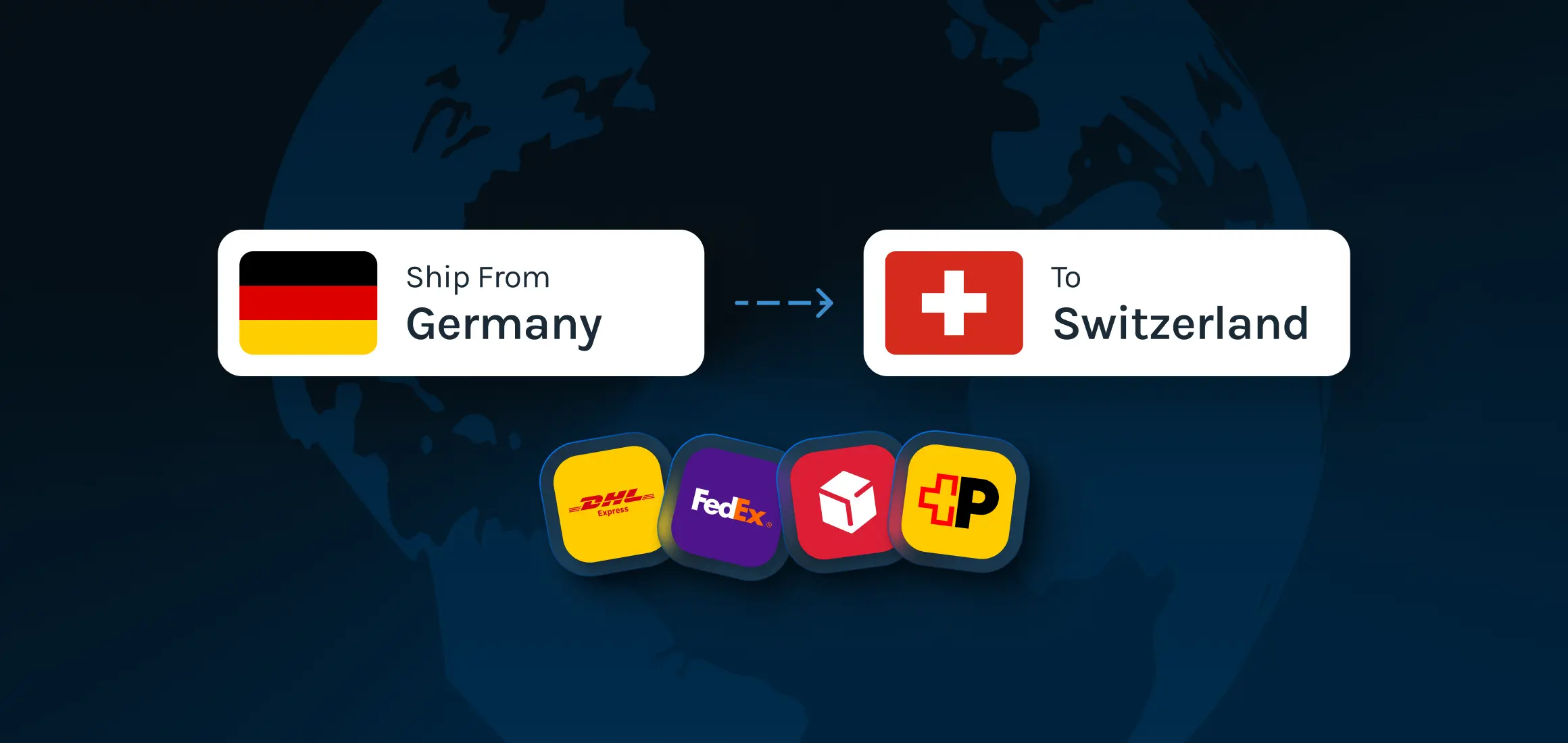
Germany to Switzerland transit has multiple global and regional couriers working to make shipping better for you. Below, some of the top couriers have been classified based on their functions, customs handling, and what they are best for.
| Courier |
Typical Transit Time |
Customs Handling |
Best For |
| DHL Express |
2 to 5 working days |
Handles clearance directly, strong on this specific corridor |
Fast, time-sensitive parcels |
| Swiss Post |
2 to 3 working days |
Often the last-mile partner for other couriers inside Switzerland |
Cost-conscious, standard delivery |
| FedEx |
1 to 3 working days |
Clears customs on the sender's behalf |
Higher-value or business shipments |
| DPD |
2 to 3 working days |
Standard EU-style clearance process |
Mid-weight parcels, competitive rates |
| UPS |
1 to 5 working days |
Standard EU-style clearance process |
High-range shipments, from the cheapest shipping option to high-value shipments |
Germany and Switzerland share a long border and, in German-speaking cantons, a common language, which is why this corridor has some of the densest, most reliable courier coverage in Europe. That doesn't remove the customs step. It just means delays are usually a paperwork problem, not a network problem.
What are the Biggest Challenges Shipping to Switzerland?
Three things trip up sellers repeatedly: customs delays from incomplete paperwork, VAT bills that surprise the customer at the door (which drives refused deliveries and refund requests), and pricing in euros when Swiss customers expect Swiss francs at checkout.
None of these are hard to fix individually. They're just easy to miss when you're doing customs forms manually for every order.
How Do You Save Time and Money Shipping to Switzerland?
Automate the paperwork. Generate customs forms and commercial invoices directly from your order data so HS codes and values are consistent every time, and show the customer their full landed cost, shipping plus VAT, before they check out.
Easyship does this by pulling real-time rates from 550+ couriers, so you can compare DHL, Swiss Post, FedEx, and DPD on the same screen, generating compliant customs paperwork automatically, and showing accurate checkout rates in the customer's local currency. Sellers using this kind of setup typically cut shipping costs by up to 91% off retail courier rates and get up to $10,000 of shipment coverage included.
If you're shipping from the US rather than Germany, the customs basics work differently. Read our guide on shipping to Switzerland from the US for that route specifically.
Shipping to Switzerland from Germany is fast and routine once the paperwork is right: a customs form, an accurate invoice, and a clear read on whether VAT applies. Get those three things consistent on every order, and the border stops being the bottleneck.
Ready to see your actual rates? Compare couriers and generate compliant customs paperwork automatically with Easyship.
FAQs
What do I need to consider when sending a package to Switzerland?
Switzerland is outside the EU customs union, so you need a customs form (CN22 or CN23), an accurate commercial invoice with HS codes, and to budget for 8.1% VAT if the shipment's value clears roughly CHF 62.
How much does shipping to Switzerland cost?
Cost depends on weight, dimensions, and courier, plus VAT if it applies. Use a rate calculator for the exact courier price and a duties calculator for the tax portion.
What can you send to Switzerland duty-free?
Shipments where the VAT owed comes to less than CHF 5, which in practice means goods valued under about CHF 62, aren't taxed. Above that, standard 8.1% VAT applies, plus any category-specific duty.
How much does it cost to send a package to Switzerland?
Total cost is the courier fee plus, if the shipment's value is high enough, 8.1% Swiss VAT and sometimes a courier customs handling fee. Budget for all three, not just the postage price.
Is Switzerland part of the EU customs union?
No. Switzerland has a free trade agreement with the EU but isn't a member of the EU or its customs union, which is why parcels crossing this border need customs declarations that intra-EU shipments don't.
.svg)
.svg)




.svg)




.svg)
.svg)
.svg)

.svg)
.svg)