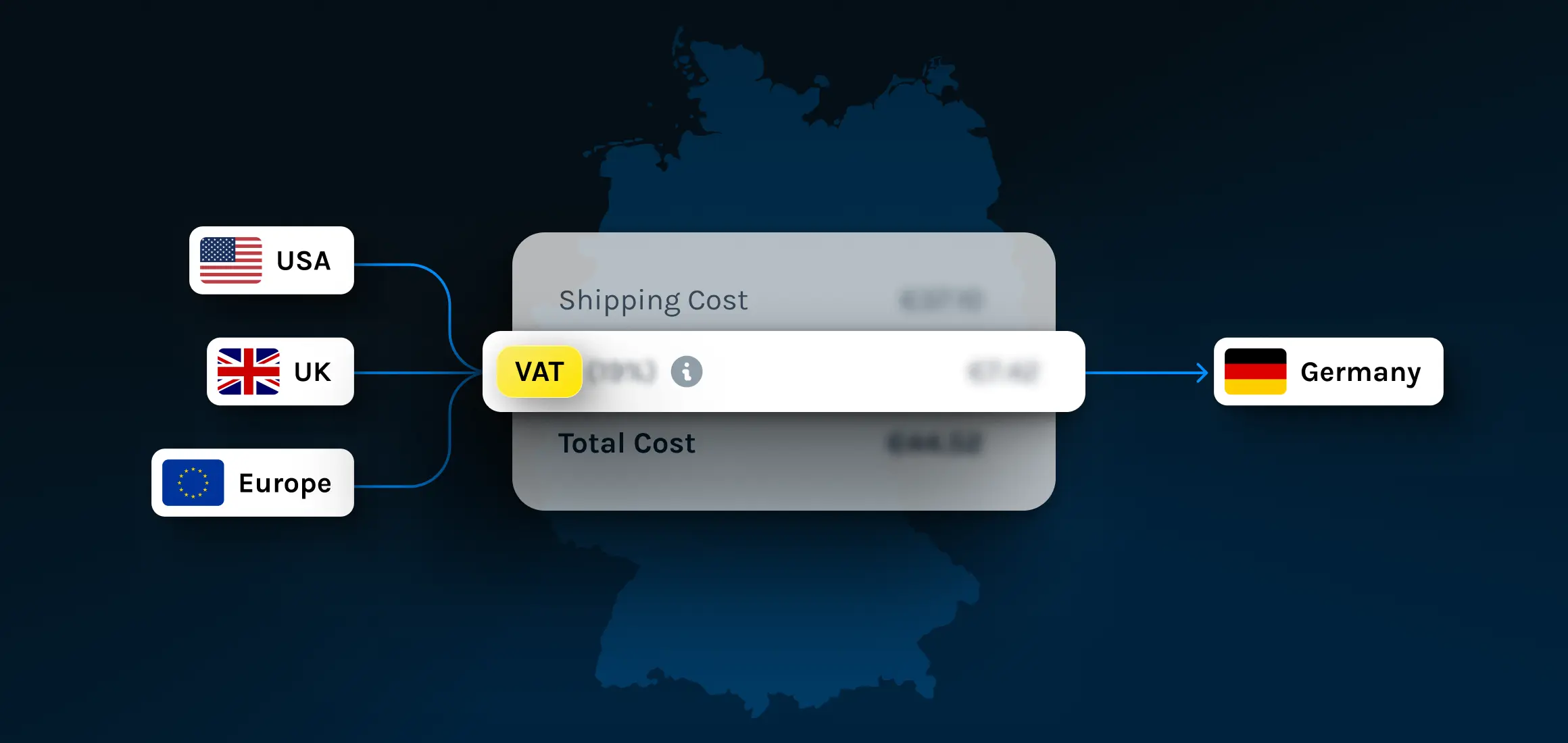
Shipping costs in Germany are generally subject to VAT. For domestic and EU sales, shipping usually follows the VAT rate of the goods, typically 19% or 7% for reduced-rate items. For imports from outside the EU, shipping and insurance costs can be included in the taxable value used to calculate import VAT.
What changes by origin is how it's collected and what extra duty applies, covered below.
Sellers who show the full landed cost, duties, VAT, and shipping combined, at checkout tend to see fewer abandoned carts and fewer refused parcels at the German border.
Easyship pulls real-time rates across 550+ courier services and can display that landed cost before a German customer pays, so nothing gets added on delivery.
What Is VAT on Shipping Costs, and Why Does Germany Charge It?
VAT on shipping costs is part of Germany’s import VAT. Customs includes the cost of the goods, shipping, insurance, and packaging when calculating the taxable value. Import VAT is then charged at 19% for most goods or 7% for certain reduced-rate items, such as books and some foods.
There's no minimum value below which this stops applying. The EU abolished the VAT exemption for imports under €22 on July 1, 2021.What changed on July 1, 2026 is separate: that's when the €150 customs duty exemption ended, adding a temporary flat €3 duty per item through July 1, 2028.
Is VAT on Shipping the Same From the US, UK, and EU?
You have to charge VAT on shipping at the same rate as the goods no matter the origin, 19% or 7%. What differs is how it's collected, what extra duty applies, and when a seller needs to register.
| Origin |
VAT Treatment |
Extra Duty |
Registration Trigger |
| US → Germany |
Import VAT (19% or 7%) on full customs value; no minimum value exemption |
Flat €3.00 per item up to €150.00; standard tariff above €150.00 |
None required for VAT itself; IOSS simplifies collection up to €150.00 |
| UK → Germany |
Import VAT (19% or 7%) on customs value; full customs declaration required |
Standard EU tariff, depending on the good's origin and classification |
EORI number required to file the declaration |
| EU country → Germany |
No import VAT at the border; treated as an intra-EU movement |
None |
German VAT applies once annual EU-wide distance sales exceed €10,000.00; use OSS |
The HS or CN code entered on the customs declaration decides which VAT rate and duty percentage apply, so classification changes the final cost, not just the paperwork.
How Do You Calculate VAT on Shipping Costs Into Germany?
German customs adds the product price, shipping cost, insurance, and any packaging costs together to get the customs value, adds any customs duty owed, then applies 19% (or 7% for reduced-rate goods) to that total. Shipping isn't taxed on its own; it's folded into the number VAT applies to.
VAT = (Customs value + Customs duty) × VAT rate
Example: a €80 product ships from the US with €20 shipping and €2 insurance. The customs value is €102. Since the consignment is under €150, the flat €3 duty applies, bringing the VAT base to €105. At 19%, VAT owed is €19.95.
What Are the Legal Requirements for VAT on Shipments to Germany?
The legal requirements depend on which scheme applies: IOSS for shipments valued at €150 or under, OSS once EU-wide distance sales pass €10,000 a year, and an EORI number for anyone filing a customs declaration.
- IOSS (Import One Stop Shop). Built for non-EU e-commerce sellers shipping direct to EU consumers, in place since July 1, 2021. It lets a seller collect VAT at checkout and remit it through one monthly return, for shipments valued at €150 or under. IOSS remains voluntary, but sellers who don't use it risk more complicated, multiple VAT registrations across EU countries.
- OSS (One Stop Shop). Built for EU-based sellers making distance sales to other EU countries. A single EU-wide threshold of €10,000 replaced the differing national thresholds that used to apply; once total EU distance sales cross that line, VAT is owed where the customer is, reported through one OSS filing rather than separate registrations in each country.
- EORI number. An EORI (Economic Operators' Registration and Identification) number is mandatory for most commercial imports into Germany. Without one, a customs declaration can't legally be filed.
What Documents Do You Need for VAT-Compliant Shipping to Germany?
A German-bound commercial shipment needs a commercial invoice, a packing list, the correct HS/CN code, and an EORI number for both sender and recipient where applicable.
- Commercial invoice: An accurate product description, for example "men's T-shirts, 80% cotton, 20% polyester" rather than "clothing"; the true market value and currency; and freight and insurance shown as separate line items, since customs will estimate them, usually at a higher figure, if they aren't.
- EORI number: required on the invoice for both parties; without it, the shipment can't clear German customs.
- HS/CN code: A minimum six-digit classification that determines duty and VAT rate.
- Entry Summary Declaration (ENS): filed by the carrier through ICS2 before the shipment arrives in the EU, required for UK-origin parcels.
Missing or incomplete documentation is one of the most common reasons a parcel gets held at German customs.
Are There Tools That Calculate VAT and Shipping Costs Automatically?
Yes. Several shipping platforms calculate landed cost, VAT, duty, shipping, and courier fees together, automatically at checkout or at label creation, instead of requiring a manual HS-code and rate lookup per shipment.
Checking VAT rates, HS codes, and duty thresholds by hand for every SKU doesn't scale past a handful of orders a week.
Easyship's tax and duty calculator dashboard compares 550+ courier services side by side, showing the cheapest, fastest, or best-value option for each shipment, and can surface real-time rates at checkout so your customers see their full cost, VAT included, before they pay.
Check out Easyship’s Tax and Duty Calculator for your shipment!
What Happens if VAT on Shipping Is Calculated or Declared Incorrectly?
Germany's Fiscal Code sets out interest on unpaid import duties and VAT under sections 233 to 237, and late-payment penalties under section 240.
- VAT errors can be costly. A shipment may be held at customs, with interest charged on underpaid VAT.
- Repeated OSS or IOSS non-compliance has consequences. Missing several filing or payment deadlines can lead to exclusion and a two-year re-registration period.
- Incorrect customs details can delay delivery. Missing HS codes, wrong invoice values, or no EORI number may hold parcels at the border.
Getting the details right before shipping saves time and cost. Check the commercial documents, HS code, VAT, and registration status in advance.
Get VAT-Compliant Shipping to Germany Right the First Time
Getting the classification, documentation, and registration right before a parcel ships costs less than fixing it once German customs flags it.
Easyship compares landed cost, VAT included, across 550+ couriers and can show German customers their full price at checkout, before they pay, not after.
Sign Up For Your Free Account!
FAQs
Are shipping costs VAT exempt in Germany?
No. You pay VAT on shipping at the same rate as the product, either 19% or 7%, because shipping costs are added to the goods value before VAT is calculated. There's no separate exemption for the delivery charge itself.
Do I pay VAT on shipping costs from the UK to Germany?
Yes. UK exports can be zero-rated for UK VAT, but the shipment becomes an EU import once it reaches Germany, and the German buyer has to pay import VAT on the combined goods, shipping, and insurance value.
Do you have to charge VAT on packaging costs too?
Yes. Packaging and container costs incurred to get the goods to Germany are added to the customs value the same way shipping and insurance are, so they're taxed at the same VAT rate as the product.
What's included in "VAT plus shipping costs" on a customs declaration?
The customs value used to calculate VAT includes the goods price plus transport and insurance costs to the EU border, added together as one figure. VAT is then applied to that total plus any customs duty, not to the goods price alone.
Does VAT apply to shipping for low-value online orders?
Yes. The EU has required VAT on every commercial import, regardless of value, since July 1, 2021. Since July 1, 2026, shipments at or under €150 also carry a flat €3 customs duty on top of that VAT.
What's the best way to check VAT rates before shipping to Germany?
Look up the product's HS/CN code in the EU's TARIC database, which shows the applicable VAT and duty rate. Shipping platforms that calculate landed cost automatically remove the need to check each SKU by hand.
Do I need to register for German VAT if I only ship a few parcels a year?
Not usually. US and UK sellers pay import VAT per shipment without a German VAT registration. EU-based sellers only need to register, or use OSS, once their total EU distance sales exceed €10,000 a year.
.svg)
.svg)




.svg)







.svg)
.svg)
.svg)

.svg)
.svg)